
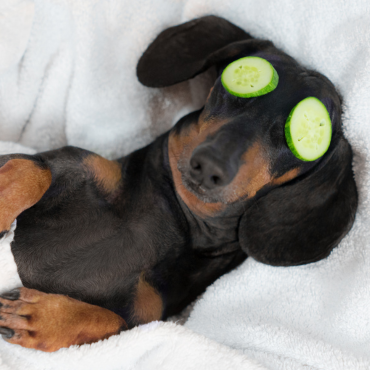
The role of the skin – why your dog’s skin matters
I’m not going to start with – and I’m not going to end up saying later – that only our products are “the best” and everything else is bad. That would be a lie.
I want to share general facts with you that will help you make more confident decisions when choosing care products for your dog, instead of relying on random people’s opinions or anonymous online profiles.
You were happy you made it to the end of yesterday’s “smartypants” post, right? 😄
Today we’ll do a little more smartypants-ing — only so you can better understand how your dog’s skin works and what it does… beyond simply “holding your dog together” and growing fur 🙂
Skin is a complex organ
The skin functions as a complex organ. It communicates with the rest of the body through systemic pathways, including:
-
the nervous system
-
the kidneys
-
the liver
-
the digestive system
-
the lymphatic system
The body can also eliminate some accumulated toxins through the skin.
Herbalist Samuel Thomson once said:
“Disease radiates from the inside to the skin.”
Suppressing symptoms can disrupt the immune system and push imbalance deeper into vital organs such as the liver, kidneys, pancreas, nervous system and digestive tract.
Skin is part of the integumentary system
The skin is part of the integumentary system, which includes:
- ears and ear canals
- coat/fur
- nails, claws
- sweat and scent glands
- tail
- lymph nodes
As I mentioned at the beginning, skin really does “hold a dog together.” It keeps internal organs, muscles and connective tissue in place.
In a way, skin gives the body its final shape.
Interesting fact: A dog’s skin makes up roughly 12% of its body weight. This can vary by breed, but it’s still an impressive number.
What the skin actually does
Here comes the interesting part: skin contains vitamins, fats, proteins and electrolytes — all essential for a healthy body.
It also:
- prevents dehydration
- regulates temperature
- helps excrete water, salt and organic waste
Did you know a dog’s skin is thinner than human skin, and about 95% of it is covered by fur?
What you put on the skin can go “inward”
I didn’t want to get too “science-heavy,” but it’s important if you want to understand why it matters what you use on your dog — what you bathe them with, rub on, drop in, or spray (for example, against biting insects).
Anything that comes into contact with your dog’s skin can, in a way, travel straight inward — and from there, right to the liver (I wrote yesterday in my #torkoscsütörtök post — basically a “foodie Thursday” — how important the liver is) and to other detox and “processing” organs.
And when these organs get overloaded and can’t store any more toxins… where do you think the body sends the unwanted “treats” back?
Exactly. Mostly back to where they came from: out through the skin.
That’s when you often see:
- scratching
- rashes
- itching
- allergy symptoms
- fungal issues
- mange/follicle mite problems
“You shouldn’t bathe dogs too often” — is that true?
I often read that you shouldn’t bathe dogs frequently because it removes the beneficial oily layer from the skin, leading to dandruff, dryness and itching.
That is partly true.
But this mainly happens if you bathe your dog with a low-quality shampoo. And it’s worth emphasising: expensive doesn’t always mean good.
There are very expensive shampoos I wouldn’t even flush down the toilet — they contain so many harsh chemicals that I wouldn’t want to harm the environment with them.
Always check the ingredients
Every single time you buy any grooming product for your dog, check what’s inside.
Because in pet cosmetics, ingredients can still be approved today that have long been banned in human cosmetics — because they are proven to be harmful and may even be carcinogenic.
I don’t want to start a “naming and shaming” campaign, and I’m not going to list what you shouldn’t buy.
A while back I made an infographic that helps you compare shampoos more easily — and you can even use it for choosing your own personal cosmetics. You’ll be surprised how many shower gels and shampoos you’ll stop buying 😄
How and why we developed My Bulldog Shop products
There are very few dog grooming products available here that I would honestly approve of with a clear conscience.
Not because I’m bitter or jealous when others start making dog cosmetics too — but because ingredients and formulas often aren’t properly thought through.
Sometimes they’re “chemical-free,” but still not well formulated. (That’s just my opinion.)
When we started developing My Bulldog Shop products, I tested every single one on myself first.
I wouldn’t put it on Bosco (back then he was our only dog) if it wasn’t good for my own skin.
My skin gets red from almost everything. When I was a baby, I even spent days in hospital because my entire body broke out in a rash.
So if something passes the test on my skin without irritation, it shouldn’t cause problems for dogs either 🙂
Most of you already know: all our ingredients come from reliable sources, they are certified, and our herbs are high-quality and used for their beneficial properties.
I won’t compromise on this — and I never will. Growth and volume will never come at the expense of quality.
Have a healthy day!
Magyari Detti
canine herbalist


